Replit vs Lovable,for a small live app.
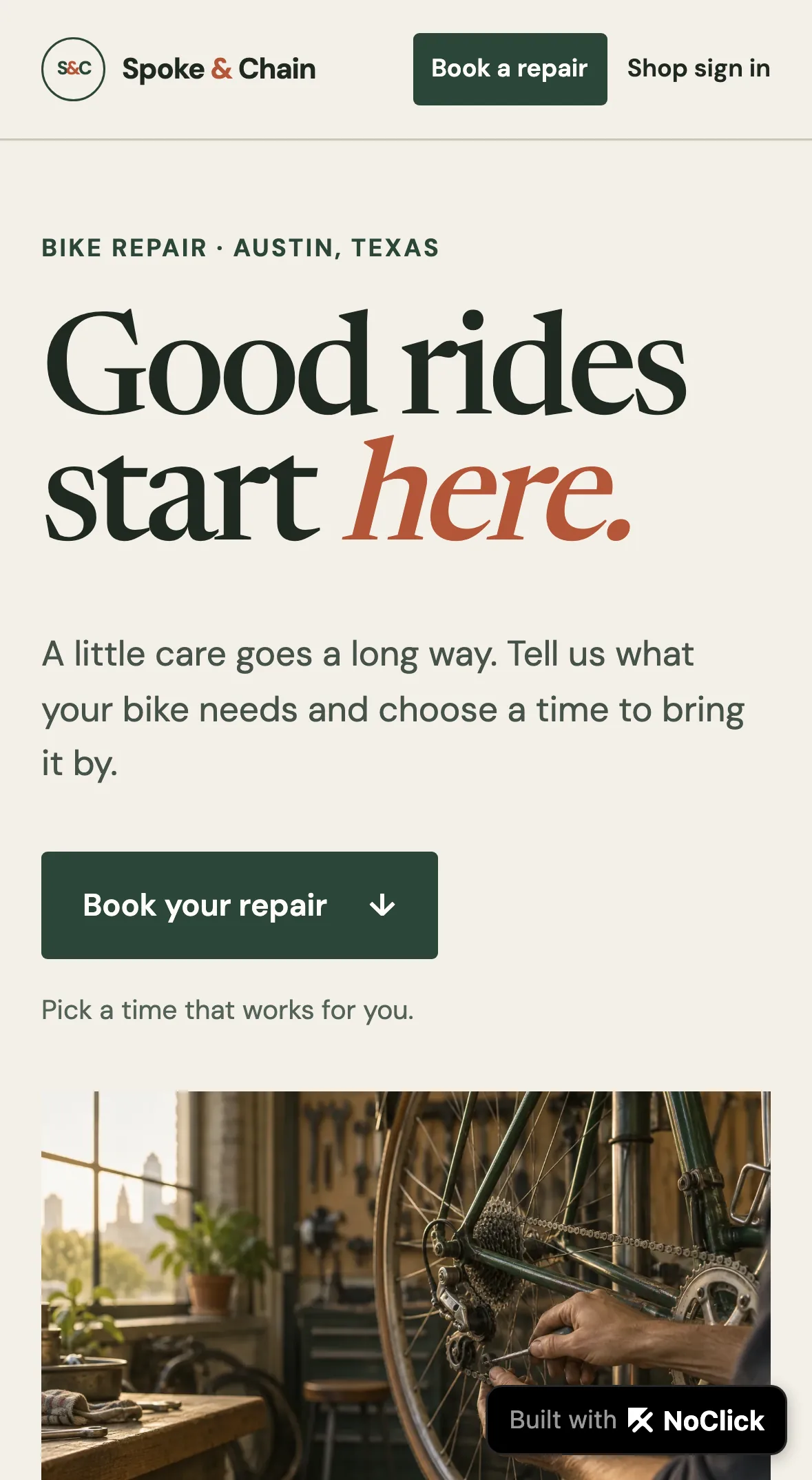
Build me a booking app for my bike repair shop, Spoke & Chain in Austin. … Put it live.
Your booking app is live: https://
NoClick, 9 minutes later
A small app, a month.
Where each one wins.
Bring the app you built.
Send its GitHub link. NoClick puts it live.
I built my app on Lovable. The code is in this public GitHub repo: github.com/…/kind-deeds-united. Copy it over and put it live here.
Your app is live: https://
NoClick, 3 minutes later
More comparisons.
Questions
For your own domain, a database, about 2,000 visits and 20 edits a month: Replit is $20 a month on Core and Lovable $25 on Pro, billed monthly. Replit Core’s $20 of credits cover building, hosting and databases and don’t roll over; past them it’s pay-as-you-go or a credit pack from $100 (docs.replit.com/billing/managing-spend). Lovable Pro’s 100 credits roll over for a month, and 50 more cost $15; Free can’t buy more (docs.lovable.dev/introduction/credit-top-ups).
Replit bills publishing by use, from the plan’s credits first: an Autoscale app is a $2 monthly base fee (its August 2026 price update says $1) plus $0.40 per million requests and $0.60 per million compute units, and a static one is free plus $0.05 a GB (docs.replit.com/billing/deployment-pricing). Replit’s PostgreSQL is free while you build; a production database is $0.16 an hour while it’s queried (it sleeps after 5 idle minutes) and $0.35 a GB a month (docs.replit.com/billing/aug-cloud-billing-updates). Lovable includes hosting: a live site uses no credits on its own and no plan caps visitors or bandwidth; its backend draws on credits after a 20-credit monthly Cloud grant (docs.lovable.dev/features/hosting). Lovable Cloud gives each app a database, sign-in, storage and functions, built on Supabase; larger database sizes cost more credits an hour, at rates the app shows rather than publishes (docs.lovable.dev/features/cloud).
A replit.app address is free, and you connect your own domain by paying your registrar; a Starter app goes down after 30 days, so an app that stays up needs Core, $20 a month (docs.replit.com/billing/plans/starter-plan). Removing the “Made with Replit” badge needs Core (docs.replit.com/billing/plans/starter-plan). On Lovable, connecting your own domain needs Pro, $25 a month; every plan publishes free on lovable.app (docs.lovable.dev/introduction/subscription-plans). Removing the “Edit with Lovable” badge needs Pro (docs.lovable.dev/introduction/subscription-plans).
Any Replit project downloads as a zip from its file tree, and its Git pane connects it to GitHub (docs.replit.com/help/projects-and-files). Lovable’s Git sync with GitHub, GitLab or Bitbucket is on every plan, Free included; downloading the code needs Pro (docs.lovable.dev/introduction/subscription-plans).
A small live app: your own domain, a database, about 2,000 visits and 20 edits a month. For each builder it’s the cheapest plan that puts an app on your own domain, billed monthly, from its own pricing page on October 24, 2026; usage past a plan’s credits costs more. On NoClick every service is at cost: hosting $0.02 at $1.90 per million requests, the database under a cent, and 20 edits $2.02, at the 10¢ an edit measured on the app pictured, which cost 10¢ to build from one message. That’s $2.04 of usage, inside the $5 a month Free includes, so the bill is $0; Member is $25 a month and removes NoClick’s badge. NoClick charges every service at what it costs NoClick, with nothing added. Free includes $1 of usage a day, up to $5 a month, and adds a 15% fee when you add funds for more. Member is $25 a month with $10 of usage included, a 5% fee on funds, and no NoClick badge on your apps. Your own domain connects on either plan; a .com bought through NoClick is $12.99 the first year (buying one needs a $5 balance from funds you’ve added).
Yes: NoClick. Text it the app you want; it goes live. NoClick hosts at cost: a small app with 2,000 visits a month is about 2¢, and its SQLite database (or Postgres) is priced by size and rows. NoClick connects your own domain on Free: you add the two DNS records it gives you. NoClick shows a “Built with NoClick” badge on Free; Member, $25 a month, removes it. An app you built elsewhere comes over from its GitHub repo.